

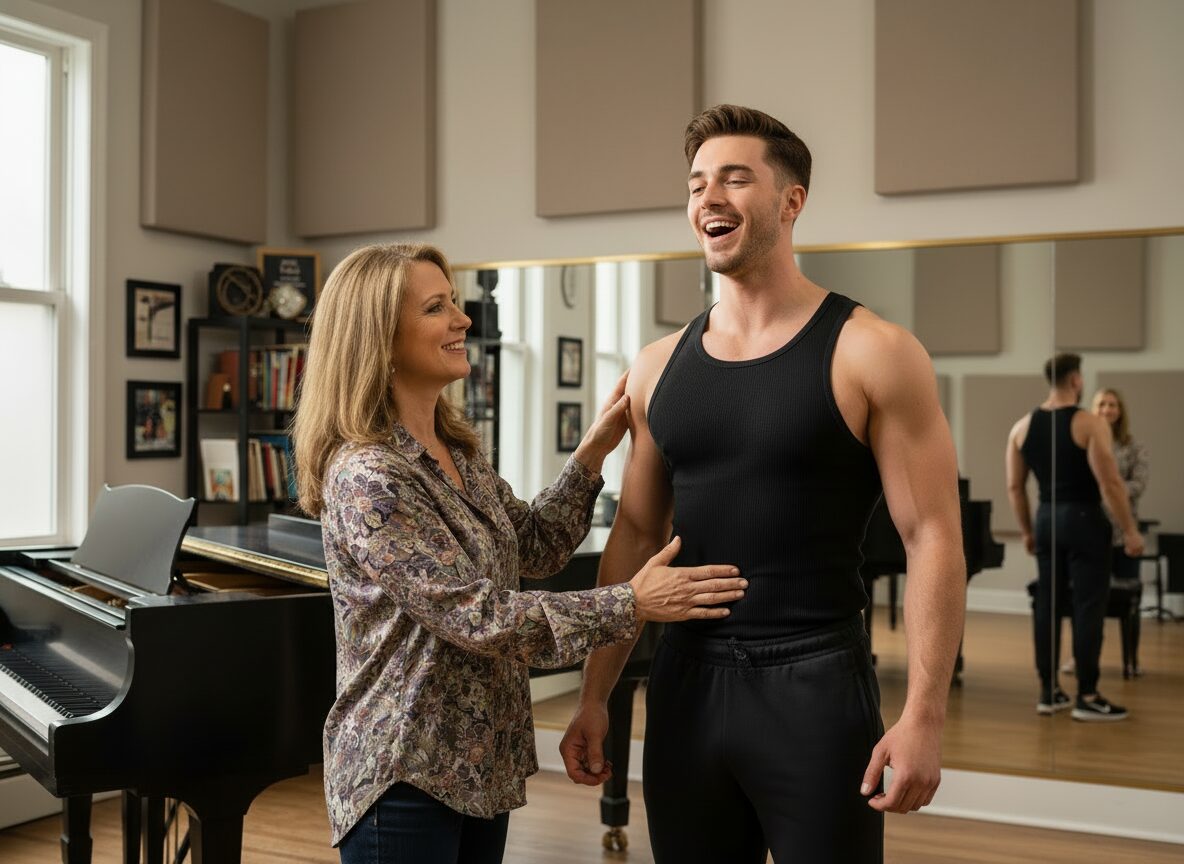
Healthy Belting: The Complete, No-Stress Guide for Musical Theatre Singers
Healthy belting is not pushing, yelling, or “giving it all you’ve got.” It’s a coordinated, balanced, efficient setup that produces powerful sound with **less effort**, not more. When done correctly, belting feels grounded, resonant, and free — never painful or tense.
This is the guide I wish every singer had on day one. It will walk you through:
- How healthy belting actually works
- What separates safe technique from dangerous habits
- Step-by-step exercises you can use immediately
- How breath, resonance, and vowel strategy unlock effortless power
- Why belting is different in musical theatre vs. pop
Whenever you feel strain, tension, or inconsistency in your belt, return to this page. It’s a complete reference for a lifetime of powerful singing.
Why Healthy Belting Matters
In modern musical theatre, belting is expected. Contemporary scores demand:
- Intensity without screaming
- Emotional authenticity
- Dynamic range from soft to explosive
- Sustained high notes night after night
But belting is also the technique singers injure themselves with most often — not because it’s inherently dangerous, but because most singers learn it by imitation instead of understanding the mechanics.
Healthy belting gives you:
- Longevity — sustainable performance over long runs
- Consistency — dependable results even when tired
- Freedom — no pushing, straining, or muscling through
- Stamina — the ability to “power up” without blowing out
If you’ve ever thought belting “just isn’t for me,” this article is your reboot.
How Belting Actually Works (The Simple Explanation)
Belting is simply a high-intensity chest-mix configuration shaped by:
- A stable, neutral larynx
- High airflow efficiency without pushing
- A lifted soft palate
- Forward, bright resonance
- Speech-like vowels modified for ease
Think of belting as energetic speech on pitch with healthy acoustic strategy. If you can speak loudly without strain, you can learn to belt safely.
Common Belting Mistakes (and the Easy Fixes)
1. “Reaching” for the note
Symptom: chin lifts, larynx rises, tone becomes thin or shouty.
Fix: Think “down and forward,” not “up and back.” Keep the head level and the jaw loose.
2. Pushing too much air
Symptom: throat tightens, voice cracks on high notes.
Fix: Switch to a slow, steady airflow. Think resist the breath, don’t blast it.
3. Tight vowels
Symptom: “EE” and “OO” feel strained.
Fix: Modify vowels toward “UH,” “EH,” or “AH.”
4. Trying to “muscle” the sound
Symptom: neck tension, jaw tension, soreness after singing.
Fix: More resonance, not more force.
Before You Belt: Your Alignment Checklist
- Jaw releasing downward, not forward
- Tongue relaxed and resting forward
- Sternum buoyant, not collapsed
- Pretend someone gently pulls a string from the crown of your head
- Belly and ribs free to expand for breath
Healthy Belting Exercises That Actually Work
Use these daily. They build coordination without strain.
Exercise 1: The Sigh-Up Speech Belt
Purpose: Build forward resonance + gentle airflow.
How to do it:
- Say “Hey!” as if calling to someone across the street.
- Notice how bright, forward, and speech-like it is.
- Now slide the pitch upward while keeping the same speech energy.
Link to future article: Understanding Resonance for Musical Theatre Singers
Exercise 2: The “Nay Nay Nay” Twang Drill
Purpose: Lift resonance into a bright, healthy mix-belt.
How to do it:
- Make a bratty “NAY NAY NAY” on a 5-note scale.
- Keep the sound narrow, bright, and forward.
- Never push — let resonance do the work.
Twang is the safest path to a high-intensity belt.
Exercise 3: The AH → UH Vowel Modification
Purpose: Reduce tension on high notes.
Try belting an “AH” up high.
If it feels tight, gradually move it toward “UH.”
This technique is expanded in our vowel guide:
Vowel Modification for Safer Singing
Exercise 4: Belt Onset Training (“Tiny Explosions”)
Purpose: Balance airflow with vocal fold closure.
- Say “BAH” strongly, like barking.
- Now sing “BAH” on a pitch — short, energetic, clean.
- Move to 3-note “BAH-BUH-BEE.”
These onsets create clarity without squeeze.
Troubleshooting: Why Your Belt Might Feel Hard
Tension in the tongue
Fix with:
Tongue Tension Release Guide
Jaw stiffness
Fix with:
Jaw Relaxation for Singers
Running out of breath
Fix with:
Breath Management vs. Breath Support
Voice cracking
Fix with:
Why Your Voice Cracks
How Healthy Belting Is Different in Musical Theatre vs. Pop
Musical Theatre Belt Requires:
- More brightness for text clarity
- More speech-like vowels
- More dynamic range
- Stronger character intention
- Narrative clarity — acting through song
Explore more:
Acting Through Song
Your Next Steps (A Mini Roadmap)
If you want a powerful, healthy belt, follow this path:
- Master breath management
- Develop forward resonance
- Blend chest and mix smoothly
- Use vowel modification on high notes
- Add character intention to energize the sound
Continue your journey with these essential guides:
Ready for Coaching?
If you want expert help building a strong, sustainable belt you can rely on in auditions and performances, I offer:
- Online coaching worldwide
- In-person coaching in Southern California
- Audition prep + repertoire building
- Technique rehab after fatigue or injury